

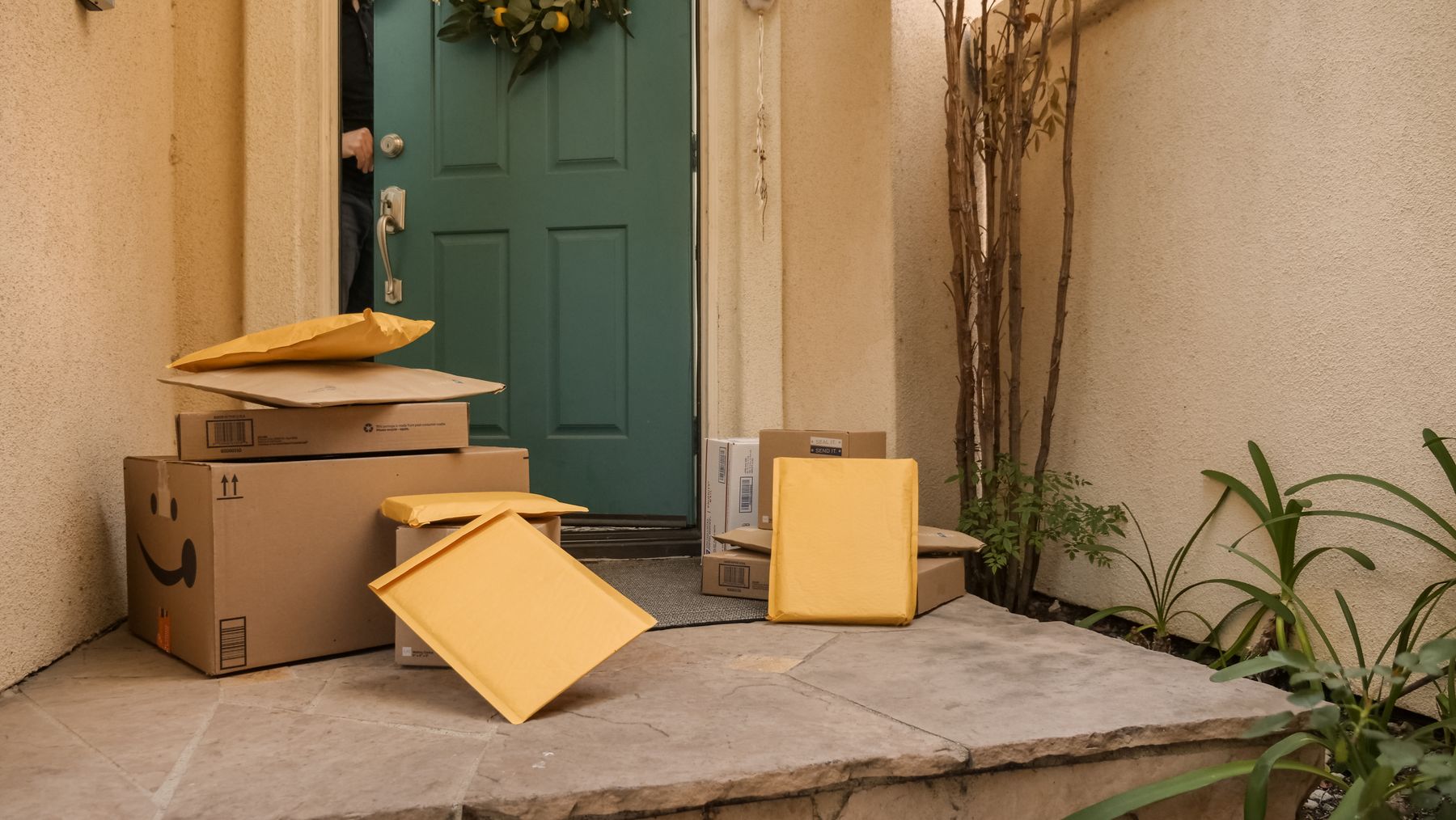
I’m going to say something that might surprise you: I will defend my Amazon Prime.
I know shit’s fucked. I know about the data centers and the water. I know the small businesses are disappearing. I know about global warming. I’m not unaware, and I’m not pretending it doesn’t matter.
But I’ve come to believe that a lot of the guilt we carry about our personal consumption was put there on purpose. And any shame that makes you small is its own kind of propaganda.
Your carbon footprint was a marketing campaign
Let’s start with a phrase you’ve probably used yourself: your carbon footprint.
In the early 2000s, BP hired the PR firm Ogilvy & Mather to overhaul its image. The result was the “Beyond Petroleum” campaign, on which BP reportedly spent more than $100 million a year from 2004 to 2006. As part of it, BP promoted the idea of a personal carbon footprint and launched one of the first carbon footprint calculators on its website. In 2004 alone, 278,000 people used it to measure their own impact on the planet. Ads stopped ordinary people on the street and asked them about the size of their footprint.
Think about what that did. One of the largest oil companies in the world, pumping millions of barrels a day, got all of us to look away from their crimes, to our own unavoidable buy-in of the system that surrounds us. The conversation shifted from what BP was doing to what you were doing. Climate change became a personal moral failing, something to fix with a better lightbulb and a reusable bag.
BP disputes this. It says other groups had popularized carbon calculators first. But by most accounts, the phrase was rare before the campaign, and the framing it spread is still with us. Oxford named “carbon footprint” its UK word of the year in 2007.
It’s a pattern, not a one-off
BP didn’t invent this playbook. In 1971, Keep America Beautiful, a group backed by beverage and packaging companies, ran its famous “Crying Indian” ad, with a tear rolling down a man’s face at the sight of litter. The message: people start pollution, people can stop it. The companies making the disposable bottles and cans weren’t the problem. You were, for dropping them.
Then came plastic recycling. In 2020, an NPR and PBS Frontline investigation found that the plastics industry, made up of the country’s biggest oil and gas companies, spent millions telling the public that most plastic could and would be recycled, while internal documents showed they knew it wasn’t economically viable. Less than 10% of plastic has ever been recycled. A former head of the industry’s trade group told reporters that if the public thinks recycling is working, it won’t be as worried about the environment.
Meanwhile, the 2017 Carbon Majors Report traced 71% of global industrial greenhouse gas emissions since 1988 to just 100 fossil fuel producers, counting both their operations and the burning of the fuels they sell. ExxonMobil, Shell, BP, and Chevron are among the biggest investor-owned emitters on that list.
The pattern is always the same. The producers make the product, profit from it, and then sell you the guilt.
Shame that makes us small is propaganda
Here’s what all of these campaigns have in common: they make you small.
They teach you to spend your energy auditing your trash, your straws, your shipping boxes, while the systems that actually drive the damage keep running untouched. They keep you busy, guilty, and quiet. A person consumed by personal purity doesn’t have much left over to challenge power, build something new, or chase their real purpose.
I know because I played that game. In the early 2000s, I was all in on slow fashion and eco-friendly everything. And it made me smaller. It shrank my art, my output, and my sense of what I was allowed to want.
So now my values are about not shrinking. About not being made small. That doesn’t mean I stopped caring about the earth. It means I stopped letting an oil company’s ad agency decide where my guilt goes.
Why it works for me
Should everyone use Amazon? No. But for me, it helps me maximize my true heart’s mission.
I work a full-time job, I’m a full-time student, and I’m a pop star and a cult leader. I’m trying to maximize every moment I have for creating art and making the world a better place. Living in this expanded age, with a massive influx of information, my mission requires a massive amount of material goods. That’s because I’m an American, an artist, a Leo, a maximalist, and someone obsessed with progress.
I have a song called “Spiritual Evolution of American Consumerism,” and in it I sing that we mastered material distribution with overseas shipments. That’s my shout-out to Amazon, because honestly, that shit is like manifestation. I think of a soldering iron, a fan, a sheet of aura glass, and it shows up at my door.
When something genuinely serves your higher spiritual purpose, using it isn’t selling out. It’s alignment.
Where responsibility actually belongs
This isn’t a free pass. I still have to contend with the fact that my consumption may cause damage. I just think responsibility scales with power.
As a business owner, that’s where I feel truly accountable. When I make something, I get to decide what it’s made of and where it goes when it’s done. Most of what I create is designed to return to the earth. The electronics I’m about to release are as imperfect as any other electronic, and I have to own that and work to offset it.
That’s the shift I’d ask you to make too. Put your energy where it has leverage: into what you build, what you vote for, what you demand from companies, and what you create for the world. Not into a lifetime of shrinking yourself to pay off a debt someone else’s marketing department wrote in your name.
A better Amazon
I don’t think the answer is to burn Amazon down. I think the answer is to transform it.
We’ve already built the most powerful material distribution system in human history. Right now it’s built around single-use goods and single-family ownership: you buy a thing, you use it a few times, and it ends up in a closet or a landfill. Imagine instead that Amazon became a material handling and distribution company, where you could use anything you need and then return it for someone else to use. Tools, gear, clothes, supplies, all of it circulating through a shared system instead of being bought and thrown away.
The infrastructure is already there. What has to change is the model, and the mindset behind it.
I lay out this theory in my book A Spiritual Approach to Emergent Technology. If you want to go deeper into how our technology can serve both our spirits and the planet, that’s where to start. We’re in the middle of a huge transition. Let’s make sure what comes next is built for everyone.
Sources
- WBUR On Point (2023), How Big Oil helped push the idea of a carbon footprint
- DeSmog, Ogilvy
- NPR (2020), How Big Oil Misled The Public Into Believing Plastic Would Be Recycled
- CDP (2017), New report shows just 100 companies are source of over 70% of emissions
- CDP and Climate Accountability Institute, Carbon Majors Report 2017
Join UNICULT and help build Unitopia.
