

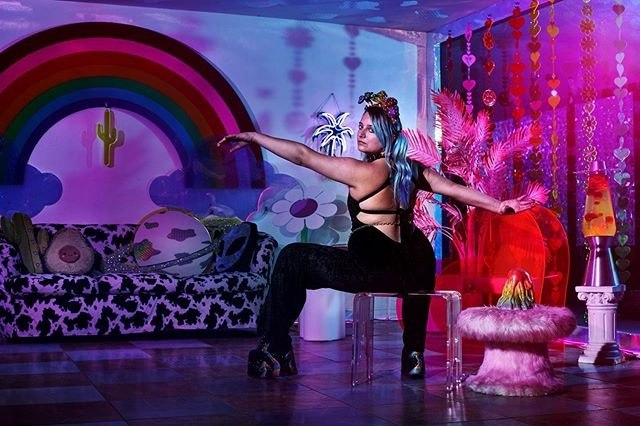
Marina Fini makes art that feels like a frequency before it feels like a category. Color, texture, mirrors, plexiglass, ritual, fashion, interiors, performance, persona, dream logic. It all arrives together. The result is a body of work that does more than decorate space. It changes the emotional temperature of a room and often the person standing inside it.
That is part of why Marina Fini matters right now. We are living through an era that keeps trying to flatten people into brands, niches, and optimized identities. Marina’s work moves in the opposite direction. It expands. It gets stranger, more sensorial, more mythic, more intimate. It insists that art can still be immersive, healing, and spiritually charged without becoming sterile or polite.
In Unicole Unicron & Friends Episode 21, Unicole talks with Marina about healing, innovation, and the courage it takes to build a life that is truly your own creation. The conversation is worth watching, but Marina is bigger than the frame of a single interview. What emerges across the interview and her wider practice is a portrait of an artist who has made worldbuilding itself into a healing language.
She treats art like an environment, not just an object
Marina Fini is often described as a multidisciplinary artist, designer, healer, and creator of immersive spaces. That description is accurate, but still a little small for what she actually does. Her work lives in the threshold between installation, interior design, performance, visual art, and embodied experience. Projects like Rainbow Bath House show how seriously she takes atmosphere as a medium. She is not only making something to look at. She is shaping what it feels like to be held inside a color field, a fantasy, a nervous system reset.
That matters because so much contemporary culture treats art as content. Marina’s practice pushes back on that collapse. She creates experiences. She creates altered states. She creates rooms where pleasure, memory, safety, style, and emotional release can all coexist. That approach makes her feel radical, not because she is chasing shock value, but because she still believes space can transform consciousness.
Outside interviews about her work often return to similar themes: color therapy, dreamscapes, radical self-expression, and the power of building environments that feel emotionally alive. Those are not side notes. They are the architecture of the work.
Healing, in her world, is not separate from beauty
One of the strongest threads in Marina’s conversation with Unicole is the idea that healing and creativity belong to the same continuum. That resonates because it matches what her art already communicates. Her visual language does not feel clinical or detached. It feels devotional. It understands that beauty can regulate, soften, open, and reintroduce people to parts of themselves they have learned to suppress.
There is a common cultural tendency to treat healing like a private cleanup project and art like a public-facing product. Marina collapses that false divide. In her practice, healing can be aesthetic. It can be playful. It can be lush, glamorous, surreal, even camp. It can involve mirrors and iridescence and pleasure, not just austerity or solemnity. That is a powerful offering in a time when many people are exhausted by frameworks that make transformation feel joyless.
The deeper point is that healing does not have to strip a person of style or weirdness in order to be real. Sometimes the opposite is true. Sometimes what heals us is permission to become more vivid. More specific. More fully inhabited.
Why Marina Fini feels radical
Marina Fini’s work feels radical because it refuses the old demand to pick one acceptable identity and stay there. She moves across mediums. She works through alter egos and symbolic language. She builds fantasy worlds without apologizing for them. She brings queerness, theatricality, mysticism, and emotional intelligence into the same frame. She makes immersion feel personal rather than corporate.
That kind of practice requires risk. It also requires stamina. Artists who build real worlds are often misunderstood at first because they are not just producing objects. They are producing context. They are teaching people how to enter the work. Marina seems to understand that instinctively. Her universes have their own logic, and that coherence is part of what makes them compelling.
There is also something politically meaningful in her insistence on enchantment. To create sensuous, healing, high-feeling environments for people who are routinely denied softness or safety is its own form of intervention. It says the imagination is not frivolous. It says pleasure is not shallow. It says beauty can be part of survival.
Plexiglass, plastic, and healing the Earth inside the duality
One of the most interesting tensions in Marina’s aesthetic world is her relationship to synthetic materials like plexiglass, shine, translucence, and plastic surfaces. For some artists, plastic immediately reads as artificial, disposable, or spiritually dead. Marina’s work suggests a more difficult and more honest question: what does it mean to make healing inside the materials of this world as it actually exists?
Plastic is part of the story of modern Earth. It is pollution, convenience, fossil residue, consumer excess, durability, toxicity, and invention all at once. It participates in the crisis. It also participates in the visual language of the era. When an artist works with that tension instead of pretending it does not exist, something deeper becomes possible.
Healing the Earth is not always about performing purity. Sometimes it begins with learning how to be in right relationship with duality. We are here inside paradox. We are trying to make beauty in a damaged world. We are trying to reduce harm while still living among the materials, systems, and contradictions we inherited. Marina’s work can be read through that lens. The gloss, the reflection, the synthetic shimmer, the ecstatic rainbow field. None of it erases the complexity. It moves through it.
That is spiritually mature territory. Real healing does not require denial of the shadow. It asks for intimacy with what is here, then a creative response. On Earth, healing often means participating consciously in the duality rather than fantasizing about escape from it. Marina’s environments understand this. They are not naive utopias. They are luminous negotiations.
The artist needed in these times
There is a reason Marina Fini lands so strongly right now. She offers a vision of the artist as healer, worldbuilder, stylist, mystic, and emotional engineer without flattening any of those roles into cliché. Her work reminds us that transformation can be sensorial. It can be communal. It can be fabulous. It can invite the body back into the process.
At a moment when so much art is optimized for speed, Marina is making experiences that ask for presence. At a moment when many people feel psychically overexposed, she is interested in atmosphere, ritual, and protection. At a moment when culture often confuses branding with identity, she is still willing to become mythic.
That may be why she feels like the healing rainbow artist we need right now. Not because she offers an escape hatch from reality, but because she shows what it looks like to metabolize reality into something more alive, more beautiful, and more possible.
If you want a direct window into her thinking, start with Marina Fini’s conversation on Unicole Unicron & Friends: https://www.youtube.com/watch?v=1WrDnKgoUO4.
