

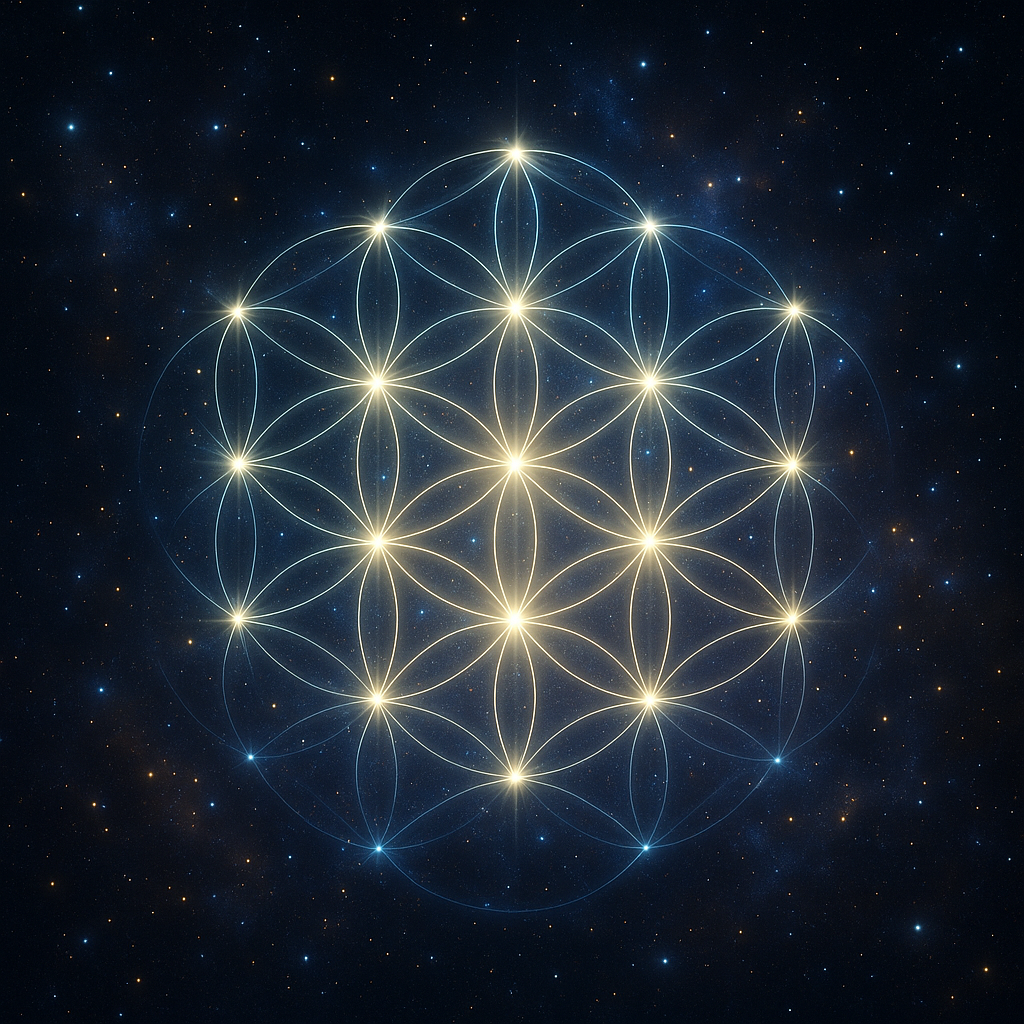
Sacred geometry shows up in a lot of spiritual contexts as imagery. Mandalas on meditation cushions. Flower of Life printed on t-shirts. Metatron’s Cube on wellness product packaging. It has become aesthetic language — beautiful, symbolic, spiritually coded.
But the reason these patterns have been considered sacred across cultures and centuries has nothing to do with aesthetic preference. It has to do with what the patterns actually describe: the way matter, energy, and living systems self-organize when functioning optimally.
That is not metaphysics. That is applied mathematics. And it has direct relevance to how conscious technology is being designed right now.
What Sacred Geometry Actually Describes
The Fibonacci sequence — 1, 1, 2, 3, 5, 8, 13, 21, 34 — appears in the spiral of nautilus shells, the arrangement of seeds in a sunflower, the branching of trees, the proportions of the human body, and the spiral arms of galaxies. It is not a human invention. It is a pattern that living systems consistently arrive at when optimizing for efficient growth and resource distribution.
The golden ratio (approximately 1.618), which the Fibonacci sequence approximates, describes proportional relationships that appear everywhere nature achieves maximum efficiency with minimum material. Architecture, music, visual composition — humans have been drawn to this ratio across cultures not because of tradition but because perception responds to it as coherent and harmonious.
The Platonic solids — tetrahedron, cube, octahedron, dodecahedron, icosahedron — are the only geometrically perfect three-dimensional forms. They are the shapes that DNA, viruses, water molecules, and crystalline structures arrive at through self-organization. They are the geometry of things that work.
From Symbol to Function
Here is where this becomes relevant to technology design rather than just art history.
Electromagnetic fields respond to geometry. The shape of a coil changes how it generates and transmits current. The arrangement of elements in a circuit affects coherence and signal quality. Materials arranged in specific geometric relationships can amplify, attenuate, or transform the frequencies they interact with.
Conventional technology design does not typically work with these principles intentionally. Circuits are laid out for efficiency in the conventional engineering sense — smallest footprint, least resistance, cleanest manufacturing. The electromagnetic output is managed for regulatory compliance, not for coherence with biological systems.
Conscious technology design asks a different question: if biological systems self-organize according to the same geometric principles that sacred geometry describes, what happens when the technology around those systems uses the same geometry intentionally?
Active Research Areas
This is not fringe territory. Researchers in bioelectromagnetics, coherence medicine, and quantum biology are actively exploring how geometric arrangement of materials affects biological outcomes.
Water structuring research — particularly the work of Gerald Pollack at the University of Washington — has shown that water in the presence of structured electromagnetic environments forms organized, gel-like layers that behave differently than bulk water. Given that the human body is approximately 60% water, how the electromagnetic environment structures the water inside cells is a question with real clinical implications.
Cymatics — the study of how sound frequency organizes matter into geometric patterns — makes visible the direct relationship between frequency and form. Different frequencies reliably produce different geometric patterns in particulate matter on a vibrating surface. The patterns are consistent and reproducible.
The Design Implication
If you are building technology that will be worn on or near the human body — or that will inhabit the spaces where humans spend most of their time — and you understand that the geometry of the device affects its electromagnetic output, and that electromagnetic fields interact with biological systems, then designing with sacred geometry is not spiritual decoration.
It is engineering toward coherence.
That is the principle behind how Dolphin Technology approaches pendant and crown design: not using sacred geometry as branding, but as the functional architecture that determines how the device interacts with the biofield of the wearer.
The tradition of calling this geometry “sacred” was the pre-scientific language for recognizing that these patterns describe something true about how systems work. The word “sacred” acknowledged importance without having the vocabulary to explain mechanism.
Now we have more of that vocabulary. The importance has not changed.
