

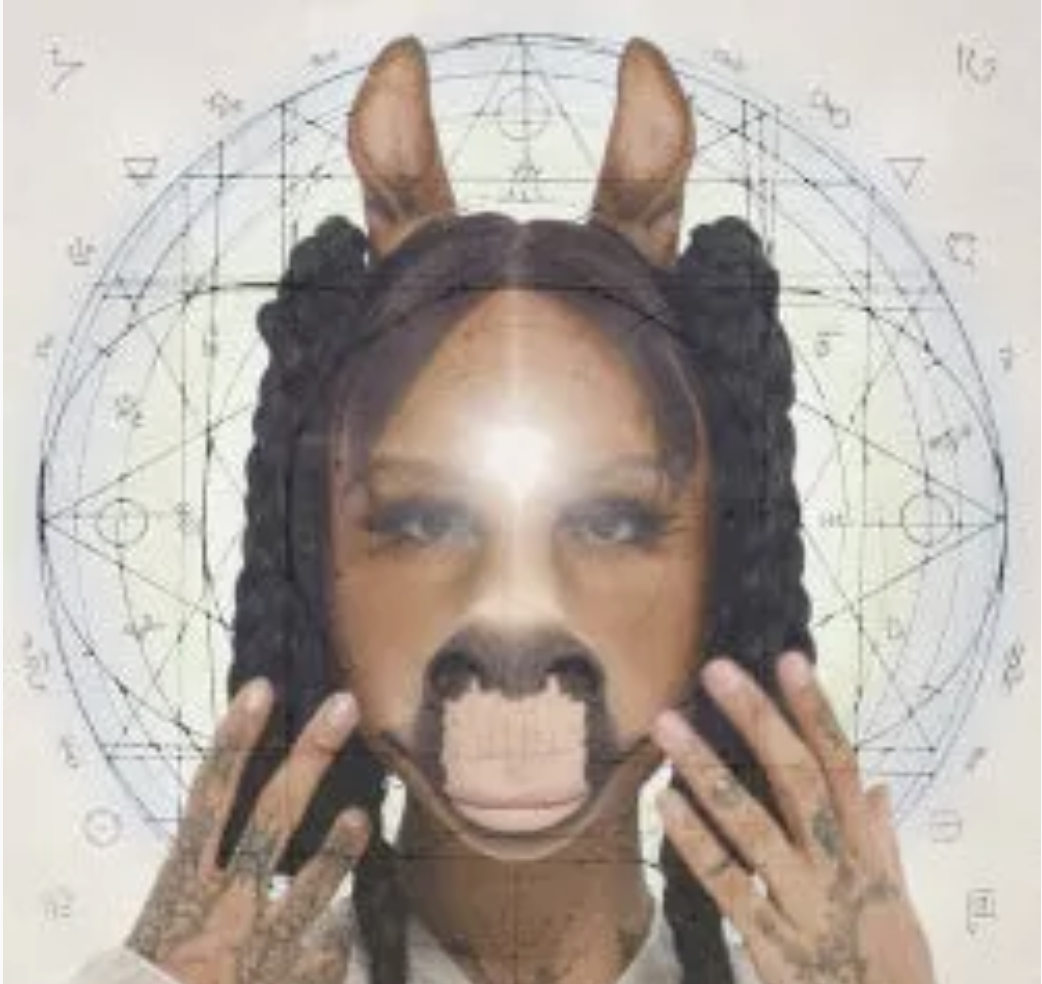
There is an artist performing in Berlin clubs, at Coachella, at Boiler Room festivals, wearing a chestnut-colored horse head mask and singing about galloping. Her name is HorsegiirL. She describes herself as half-horse, half-human. Her fictional biography places her origins on Sunshine Farms. Her fans are called farmies. And her music is genuinely, undeniably great.
While HorsegiirL is the first half-human hybrid pop-star, and her identity seems novel and unique, she shines against a dark backdrop of hidden history and conspiracy of human-animal hybrids. Conspiracies often live coded in media, and it’s hard to look at HorsegiirL without thinking of other depictions of half-human half-animal depictions. And as it turns out, the history of half-human hybrids is as old as time itself. So can HorsegiirL stand apart as a pure and innocent artist, or is she operating in an art form already heavy with context that she can’t escape?
Vibes Alone
Based on vibes alone, HorsegiirL passes the test. Her music is fun, playful, and gives no acknowledgement to any other reality than her own. She emerged from Berlin’s electronic music scene in 2022 and went viral in 2023 with “My Barn My Rules,” a high-energy Eurodance and happy hardcore track whose lyrics are remarkable for their total commitment to a single perspective: the inner world of a horse.
The central refrain:
“I walk, I trot, I lope, I gallop.”
These lyrics are innocent in the most precise sense of the word. They describe reality from inside the experience of being a literal horse or maybe a girl who is pretending to be a horse or probably more accurately, a HorsegiirL. There is no winking at the audience, no acknowledgment that this is a persona being performed. The worldview is internally consistent and completely sincere.
It’s like the weird girl from middle school who always acted like an animal became the coolest person you ever saw. And I mean it, she’s cool. Her fashion is top tier and she never lets the mask slip, literal or otherwise. It seems like she’s genuinely the most comfortable she could possibly be while wearing a horse face. You can tell, fundamentally, that she’s a hot girl baddie. And the fact that she’s sincere about being a horse is fine because she’s so confident and sure about it. Maybe it’s just her authentic expression. As a starseed, I think we should all be expressing ourselves exactly how we want to. I think we will see more of half-human hybrids in the future, and I hope they are all as joyful and free as HorsegiirL seems to be.
The Inspiration
HorsegiirL has cited Crazy Frog as the reason why she was inspired to make music, which illuminates something important about this lineage. Crazy Frog was a Swedish CGI character who topped charts across Europe in 2005 with a Eurodance cover of “Axel F” a non-human entity making club music, beloved and derided in equal measure. HorsegiirL is working in that same tradition of the non-human performer. The freedom that Crazy Frog exudes (he is crazy and he is free) is inspiring. The music he made was viral. It was good and it was unlike any other music coming out. It operated in its own genre.
Race Tracks, Race, and Identity
When Black women choose a radical identity, I think it’s smart to make space and learn. Janelle Monáe is another Black artist who used a non-human persona to say something that the human form alone could not contain. Janelle Monáe spent years performing as an android (half-human/half-computer), a Cindi Mayweather, a ArchAndroid, a being outside the categories that society uses to constrain people. Her music is about being punished for her form, and her love. The android was a vehicle for Monáe to express her queerness, her pansexuality, the feeling of being restricted and judged for how she was made.
Janelle’s early work as Cindi Mayweather is some of the best music ever made in my correct opinion. It expresses the bravery, power, deep inner knowing, and cultural ostracization of being different, of being born queer, or an alien, or even as a girl who feels like she’s a horse.
HorsegiirL may be doing something structurally similar. The mask is not a barrier to authenticity. For some artists, it is the only condition under which full authenticity is possible. It’s powerful to celebrate Black artists who explore identity and transform perception with their art.
Sorry to Bother You
In 2018, Boots Riley released Sorry to Bother You, a surrealist satire that won the Sundance Grand Jury Prize. The film follows Cassius Green, a telemarketer who climbs the corporate ladder at a company called WorryFree a corporation that offers lifetime housing and employment in exchange for labor.
(Spoiler ahead.) The film’s central revelation is that WorryFree has been secretly transforming its workers into Equisapiens: human-horse hybrids engineered to be stronger, more productive, and more obedient. Workers ingest a mutating substance, believing it to be cocaine. What emerges are beings that retain full human consciousness inside bodies that have been permanently altered for corporate utility. They are, quite literally, workhorses. The Equisapiens are not monsters. That is the horror. They are people whose bodies were hijacked in the service of someone else’s profit margin.
Riley’s metaphor is that capitalism reduces workers to horsepower in the most literal sense it can imagine. The hybrid being is the endpoint of labor exploitation taken to its logical conclusion.
Sweet Tooth
Netflix’s Sweet Tooth imagines a world where the collapse of human civilization coincides with the birth of hybrid children, part human, part animal. The series follows Gus, a gentle deer-boy navigating a post-apocalyptic landscape that can’t decide whether hybrids are the next evolution or the cause of everything that went wrong – a question we may be asking ourselves soon as technology and human potential expand exponentially.
Furry Culture
The furry fandom has been doing this for decades. A fursona, a personal animal avatar through which someone expresses their authentic identity, is one of the most misunderstood and most earnest subcultures the internet has produced. Furries are not a joke. They are people who felt, often from childhood, that the animal form expressed something true about them that the human form could not. But HorsegiirL has never used the word fursona. She has never positioned herself within that community or sought its recognition. While she never claimed to be a furry, the furry community has claimed her. On r/furry, threads about her appear with titles like “Obsessed with this little horsegirl, look at her go.” Furries were and still are heavily ridiculed and mocked. They are cool in certain sub-cultures but what’s interesting is that HorsegiirL isn’t actually niche. Her music is good enough for the main stream and performing a Coachella shows that she’s accepted by a larger audience than just the furry communities.
Is HorsegiirL a furry or something more like a half-human hybrid? She’s performing on stage in a horse-head mask, alongside these modern depictions, in a world getting more comfortable with the idea that people can be more than just human.
This Seems New. It Is Not.
A hot girl in a horse mask going viral today reads as a product of internet culture, algorithmically strange, native to TikTok and the music is worthy of the Boiler Room streams. But the image at the center of her entire project is one of the oldest figures in the human visual record. The premise of HorsegiirL is not new. It is ancient. And it has never been neutral.
Ancient Egypt built an entire cosmology around it. Anubis, god of death and the afterlife, wore the head of a jackal. Thoth, god of wisdom and writing, wore the head of an ibis. Horus, god of the sky and divine kingship, wore the head of a falcon. These were not symbolic costumes. They were theological propositions: that consciousness can occupy hybrid form, that divinity might express itself through the combination of human and animal natures, that the boundary between species is more permeable than it appears.
Saint Christopher, the patron saint of travelers venerated across the Catholic and Orthodox worlds, was depicted for centuries in Eastern Orthodox iconography as a cynocephalus, a dog-headed man. The earliest written accounts of this tradition date to the fifth century. He was said to be a member of the cynocephali, a race of dog-headed beings believed to inhabit the margins of the known world. In the medieval Irish Passion of Saint Christopher, he is described explicitly as “one of the Dog-heads, a race that had the heads of dogs and ate human flesh.” He was captured, converted to Christianity, and martyred. The Russian Orthodox Church did not formally prohibit the dog-headed icon until 1722. For over a thousand years, this was a mainstream depiction of a beloved saint.
The animal-headed being has been divine, monstrous, sacred, and satirical across every era of recorded human culture. But none of them have been pop stars.
The Beastiality Question
Bestiality is illegal in most jurisdictions and for good reason. It causes documented harm to animals who cannot consent. It is not a comfortable paragraph to write. But the question belongs in any honest analysis of what HorsegiirL’s persona actually does in the world. Her song “f0rbiidden l0ve$tory” is literally a narrated romantic attraction between species. Her identity is explicitly half-human, half-horse. She performs this at Coachella, at Boiler Room, to tens of thousands of people. She’s influencing people, whether or not it is intended.
The research on media normalization is consistent: repeated, positive depictions of a thing lower the psychological barrier to it. That is not an accusation against HorsegiirL. It is a structural observation about how culture works. So we gotta ask, does an artist who has built a globally beloved persona around the romantic inner life of a horse bear any responsibility for the edges of what that normalizes? The honest answer is probably: not more than she can control, and not enough to indict her art. She is, by every available read, a sincere artist doing something genuinely her own. But sincerity has never been a complete defense against consequence. A hot girl who thinks she’s a horse deserves to exist on her own terms. She also exists in a world with real animals in it. Both things are true at the same time, and neither one cancels the other.
Is this Predictive Programming?
There is a current of conspiratorial thought that interprets the normalization of human-animal identity in contemporary culture as something coordinated. The idea is that through media, through pop culture, through the gradual mainstreaming of transgenic research, there is a deliberate effort to prepare the public for the eventual acceptance of hybrid beings.
This is not entirely speculative in its scientific dimension. Human-animal chimera research is real, regulated, and ongoing. In 2003, Chinese scientists fused human cells with rabbit eggs. Researchers have created pigs with human blood. Human stem cells have been inserted into pig and monkey embryos to study cell integration and the possibility of growing human organs for transplantation. None of this is concealed. It is published in peer-reviewed journals and debated openly in bioethics literature.
The-powers-that-were have had a vested interest in the figure of the human-animal hybrid long before the science made it possible. The workhorse is not just a metaphor in Boots Riley’s film. It is the ideal labor unit: the strength and endurance of an animal combined with the cognitive capacity of a human, without the full moral and political status of a person. The hybrid is the logical endpoint of a system that has always sought to extract maximum labor from minimum personhood.
Which makes it worth noting that the ancient hybrid figures, Anubis, Thoth, Horus, the cynocephalus Christopher, were sacred. They were not labor. They were divine. The animal head was a mark of transcendence, not utility. The same image has carried both meanings across history. What it means in any given moment depends entirely on who controls the context.
Innocent Artist or Industry Signal?
There are two readings of HorsegiirL that cannot both be fully true but both deserve to be taken seriously.
The first: she is exactly what she appears to be. A German artist who felt called to inhabit the horse identity completely, who built a sincere aesthetic around it, who makes joyful club music from inside that worldview, and whose success reflects the genuine resonance of her art with a global audience. On this reading, any overlap with larger cultural narratives about hybrid beings is coincidental, the kind of collision that happens when a genuine artist touches an archetype that happens to be culturally charged right now. This reading is entirely plausible. It is how most artists work. The unconscious knows things the conscious mind does not.
The second: the normalization of the human-animal figure in pop culture serves a purpose. If the eventual reality is a world in which hybrid beings exist, whether through biotechnology, through whatever the next phase of the transhumanist program looks like. Then, the cultural groundwork for public acceptance needs to be laid in advance. The process has always worked this way. Ideas become normal through repetition, through art, through entertainment, through the gradual erosion of the reaction that says: this is not supposed to exist. A viral, beloved, Coachella-playing artist in a horse head mask who inspires joy and devotion in her audience is extraordinarily effective cultural infrastructure for that normalization, regardless of whether she knows it or intends it.
These two readings are not mutually exclusive. An artist can be completely genuine and still be useful to a system that did not create her but benefits from her existence. The question of intent does not resolve the question of function.
The Barn Still Belongs to Her
Maybe in the world we live in, it is okay to enjoy good vibes when you find them. The cultural waters are complicated. The historical record is dense. The contemporary context is charged with implications that extend well beyond any single artist’s biography or intention.
And none of that changes the fact that “My Barn My Rules” makes people want to move their bodies, that the farmies are a real community built on real connection, that HorsegiirL takes the stage and delivers genuine artistic presence.
An artist’s true light shines no matter the circumstances. It is obvious: HorsegiirL is a true artist. Whether the image she inhabits is ancient or contemporary, sacred or suspicious, innocent or strategic, she is doing something real inside it. And that is worth recognizing clearly, even while holding everything else in view.
