

This blog post is referencing UNICULT Cam Church | Episode 4 – The Power of Creation, which originally aired 03/26/2026. See the full episode of UNICULT Cam Church there.
You are consuming right now.
The phone in your hand was assembled by someone you will never meet, in conditions you will never see, for a price that does not reflect the full cost of what was sacrificed to get it to you. The shirt on your body was sewn by hands that never stopped moving. The wig, the fake flowers, the $11 impulse buy — all of it passed through a chain of human labor that is almost deliberately invisible.
I know this is uncomfortable. Stay with me.
Where This Started for Me
I went to school for apparel merchandising. And what I found out pretty quickly was that every single class was teaching the same thing: how do you get a piece of clothing made for the cheapest possible price?
Which country has the loosest restrictions on sweatshops? Which one has no meaningful minimum wage? Which one is desperate enough? The fashion industry has built its entire infrastructure on finding the most economically vulnerable people on earth and using them as production facilities.
That woke something up in me that I could not put back to sleep.
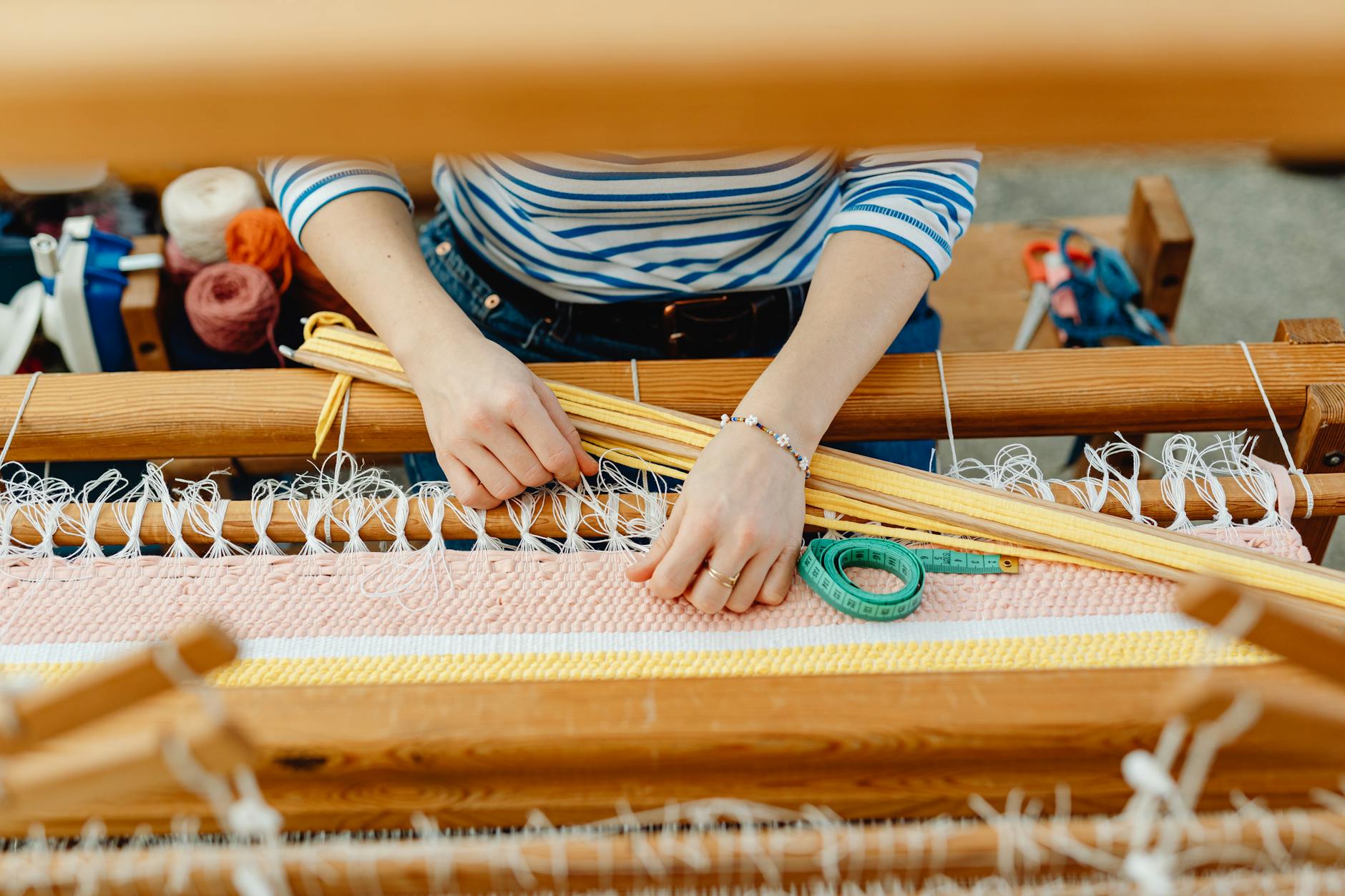
I switched my focus. I started studying the hand-making of fabric. Not as a hobby, but as a philosophy. Because I started to realize something: when we outsource creation, we outsource a piece of our humanity and our spirituality along with it.
The Self-Sufficiency Fantasy (And Why It Breaks Down)
For a while I went deep on the self-sufficiency dream. The hand-built house by the river. The farm animals. The garden. Every bowl, every chair, every piece of clothing made by my own hands from materials I raised or harvested myself.
And I thought about it all the way. If I am going to make my own clothes, I cannot just buy fabric. I have to raise the animal. Harvest the fiber. Card it. Spin it. Weave it into fabric. Then sew it into something wearable. So I looked into what that actually takes, and within five minutes I needed an electric drum carder, which meant I needed electricity, which meant I needed infrastructure.
The dream starts to collapse when you follow it to its end.
But here is what I actually learned from that collapse: we are not meant to be self-sufficient as individuals. We are meant to be community-sufficient. We are meant to specialize. The person down the street who makes beautiful tables is not a failure of your self-reliance — they are your community doing what community is supposed to do.
The problem is not interdependence. The problem is blind interdependence. The problem is when the chain of production is so long, so deliberately obscured, that we cannot see what our consumption is actually doing.
Awareness Is the First Step, Not the Last
When I talk about this, people sometimes hear it as an attack on consumers. It is not.
You can only do so much as a consumer. The responsibility for ethical production sits primarily with the people building and selling the products. If you are starting a business, you have a real obligation to know where your materials are coming from and under what conditions they are being made.
But for everyone else — for us, moving through this world and trying to live with some integrity inside a system that was not built with integrity — the first step is just awareness. Research some of the things you own. Look at how they were made. You will feel bad. That is supposed to happen. That feeling is important. Do not skip it.
And then, when you are ready, move beyond it.
The Cure
Gandhi understood this. When the British empire colonized India, they came with fabric and yarn. They made India dependent on their imports. Gandhi’s response was not a boycott, not a protest — it was a spinning wheel. He taught people to spin their own yarn. By localizing production, India starved the imperial trade of its power. Creation was the resistance.
That principle scales all the way down to your life right now.
You do not have to create everything. You do not have to be a farmer and a weaver and a carpenter and a musician. Choose one thing. One thing you feel drawn to make. It does not even have to be a physical product. Music is creation. Art is creation. A business built around your values is creation. An idea you develop into a philosophy is creation. A reality you consciously construct for yourself is creation.
Whatever the urge is that lives somewhere in your body and says I want to make something — that is a cosmic signal. Follow it.
One More Thing About Quality
Do not worry about quality. Not even a little bit. Not at first.
When I started knitting, the things I made were not good. They were lumpy and uneven and I loved them completely. Every hat and scarf I made was mine. I made it. No one in a warehouse made it for me in conditions I would not have chosen for them.
Quantity over quality when you are starting. Just make things. Let yourself be in the act of creation. The quality will come. The meaning is already there from the first stitch.
We are living in a world that has separated us from the making of things so completely that most of us have forgotten that we are makers. Consumption is not the enemy — it is natural and holy and necessary. But creation is the other half of the equation that our culture has largely deleted.
Spend your Sundays creating. And every other day too if you can.
UniBless. 🌀
You do not have to feel this alone.
UNICULT is a community of people who believe that JOY is your birthright, that ALL ONE means your healing matters, and that creation is a sacred act. We make things together. We grow together.

